Hybrid work a top priority for 72% of workers, according to GCSU’s 2026 Leadership Forecast
By Amanda Respess
T he Covid-19 pandemic changed the way the world does business, transforming worker expectations and affecting how companies attract and retain top talent.
"The new workplace,” as Georgia College & State University researchers refer to it in the 2026 Leadership Forecast — an analysis of Georgia business trends paired with actionable insights for corporate executives — is defined by a dramatic shift toward flexibility, asynchrony and distributed work, as evidenced by what workers say they value most.
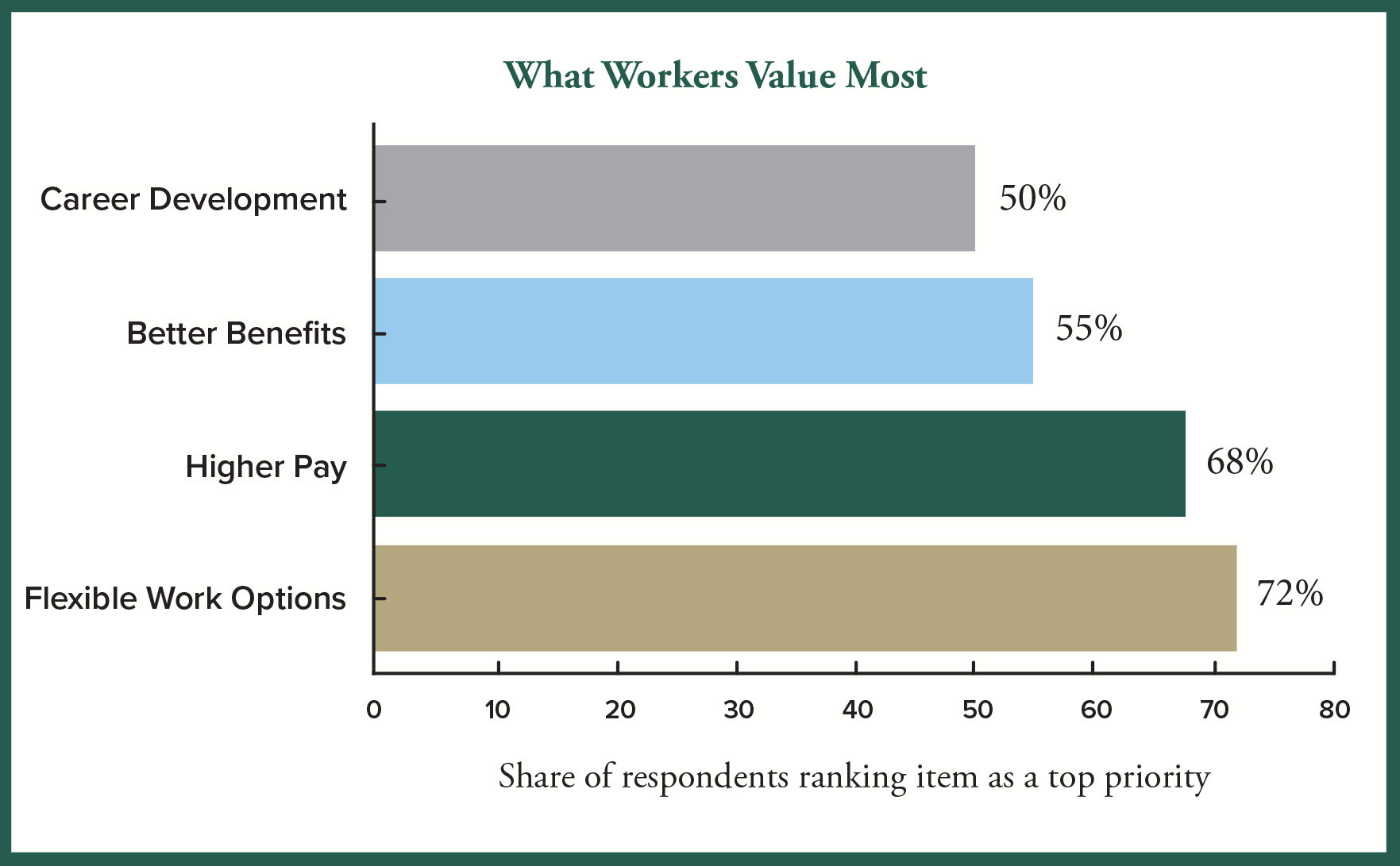
The forecast cites statistics from a Business Insider article by Beatrice Nolan and Tom Carter that found 72% of workers say “flexible work options” is a top priority. “Higher pay” came in second at 68%, with “better benefits” third (55%) and “career development” fourth (50%).
“Georgia — like much of the country — is facing a tight labor market,” Leadership Programs Director Dr. Harold Mock said. “The state's unemployment rate has hovered around 3-4% in recent years, which means employers are competing for workers.”
While employers may offer competitive wages, Mock says tighter profit margins mean companies are offering other, non-monetary benefits to attract skilled workers.
“The price of doing business has gone up pretty quickly, which means that we can't raise employee wages as much, so employers are pulling the only lever available to them,” Mock explained. “An employer might say, ‘I wish we could match your salary, but what we can do is give you two days a week to work from home.’”
Hybrid and fully remote work options remain popular, with more than 20% of U.S. workers age 16 and older working from home at least some of the time in 2025, according to data from the U.S. Census Bureau’s Current Population Survey.
However, the rapid shift to remote work precipitated by the Covid-19 pandemic is not irreversible. The Leadership Forecast — which features expert analysis across a 12-month cycle of research contributions from scholars and students, business leaders, nonprofit executives, journalists and public officials — predicts that U.S. employers will lead the transition back from fully remote jobs to more middle-of-the-road hybrid and flexible workplaces.
“Making the most of the flexible workplace requires leaders to focus on outcomes rather than presence and to reimagine the relationship between management and the teams they oversee,” the forecast concludes.
New Normal: Four Keys to Success
The Leadership Forecast also offers four tenants for the “new workplace,” which are meant to help business leaders navigate change and maximize their bottom lines. The tenants, highlighted below, are based off research findings and survey data from Georgia executives.
- Flatten Hierarchies: While hierarchy provides structure, it can also stifle innovation. Leaders and managers should clarify workers’ rights to participation versus decision making, practice collaborative problem-solving and normalize constructive dissent.
- Empower Networks: In contrast with hierarchies, which rely on command and control to reach their goals, networks incentivize self-organization, initiative and dynamism and facilitate mutual regard and respect between the leaders and the led.
- Equip Managers: The new work environment — with fewer coffee pot conversations and breakroom lunches — could remove the essential humanity from our organizations. Organizations should equip their managers with the skills to provide effective leadership: including empathy, candor, compassion, adaptability and strategic thinking.
- Focus on Talent: Organizations that nourish, upskill and empower their people will remain resilient amid demographic decline and global competition. Leaders need to focus on fostering intergenerational communication.
In addition to sharing the Leadership Forecast with university partners and the greater Georgia business community, Georgia College Leadership Programs guides discourse among faculty and staff.
“At Georgia College, we strive to provide our students with a holistic learning experience that focuses on professional development, technical skillsets and workforce readiness,” said Dean of the College of Business & Technology Dr. Amit Ghosh. “We bridge academic excellence and industry insights to prepare our students for the changing workforce and competitive labor market.”
Read the full 2026 Leadership Forecast online.
About the Leadership Forecast
The Georgia College Leadership Forecast is created by the Research & Public Service Team at Georgia College & State University, which operationalizes the major ideas gathered from classrooms, leadership clinics and forums, then conducts polling of thought-leaders. Working with faculty and fellows, the team analyzes the polling data and prioritizes major trends for publication in the annual Leadership Forecast.