Bridging Continents and Algorithms: How students tackled real-world AI at Hiperbaric
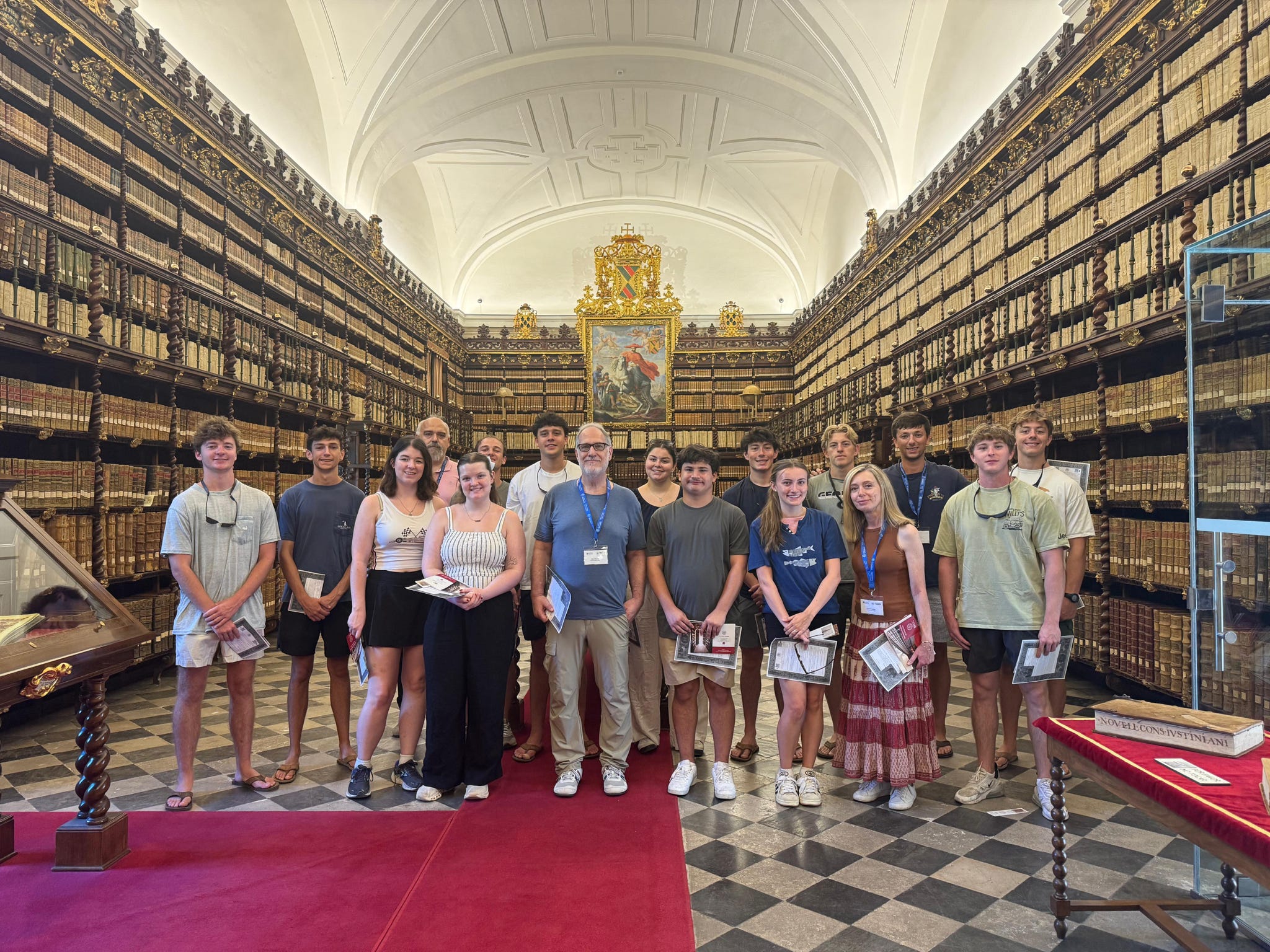
Bridging Continents and Algorithms: How students tackled real-world AI at Hiperbaric
This July, 27 university students from two countries gathered in Valladolid, Spain, to answer a question at the heart of modern industry: Can artificial intelligence revolutionize warehouse management on the factory floor?
Organized in collaboration with Hiperbaric High Pressure Technologies, the Universidad de Valladolid, and Georgia College & State University, an international hackathon put that question to the test. Fourteen American students crossed the Atlantic to join 13 Spanish peers, working in multidisciplinary, international teams to tackle a real business problem: optimizing Hiperbaric's spare parts inventory and warehouse management using AI.
Stepping onto the Factory Floor
The experience went far beyond a typical classroom assignment. The program kicked off with a visit to Hiperbaric's facilities, where students were welcomed by CEO Andrés Hernando and company leadership before touring the plant to see high-pressure processing machinery operating in real time.
For the students, standing on the facility floor made the engineering and logistical challenges immediately tangible.
"Hiperbaric tasked five different student-led teams, each made up of both American and Spanish students, to determine a solution to an actual problem within their warehouse," shared student participant Johnny Ledford. "It was an extremely valuable design-thinking process and incredible opportunity to gain real-world experience finding an AI solution for a major business."
Navigating international collaboration also proved to be a powerful learning curve.
"We were a mix of American students and students from the Universidad de Valladolid, and the language barrier was supposed to be the hard part," said Ally Glicker. "Instead, it became the useful part. We spent a while pitching what felt like competing ideas. Then it clicked: same idea, different words, different languages. We only caught it because we were forced to slow down."
Pitching to Industry Leaders
After days of intensive teamwork, all five teams presented their AI solutions to an expert judging panel that included Hiperbaric's Ramón Bustamante, director of technology and digital transformation and Guillermo Alcuaz, AI and digital transformation engineer.
The proposals showcased remarkable ingenuity. Ledford's team, "United Pressure," took first place with a design that used AI agents to track part movement and flow throughout the warehouse. Charlie Cuttino's team, "Team Windows," placed second with a hybrid proposal that paired a ticketing and inventory management system with an interactive maintenance simulation.
"My team designed a unique ticketing and inventory management system to optimize warehouse operations, as well as an interactive maintenance simulation," Cuttino said. "Building practical, AI-driven solutions alongside international peers was an invaluable lesson in cross-cultural leadership and innovation."
Hiperbaric CEO Andrés Hernando highlighted the mutual benefits of the open collaboration.
"For us, initiatives like this are an opportunity to connect with young talent, learn from them and continue fostering a culture of open innovation and collaboration with universities," he said.
A Lasting Academic Impact
Faculty leaders who spearheaded the initiative emphasized how much the experience elevated student learning. Dr. Ward Risvold noted that the group carried themselves as equals from the start.
“Our students went to Valladolid as partners, not visitors, and their Spanish teammates treated them the same way," he said. "They conducted themselves exceptionally from the first day to the last, and they took full advantage of everything Spain offered them, intellectually and culturally. An experience like this reshapes how a student understands their field and place in the world.”
Caroline Collier saw that same transformation up close, and found herself changed by it too.
“What made this collaboration so powerful was the growth it demanded of our students," she said. "They adapted in real time to a new language, culture and ways of thinking while working with the Spanish students and helping an innovative company like Hiperbaric solve a real business challenge. Our students returned changed, and so did I. Thank you to the Universidad de Valladolid and Hiperbaric for this life-changing experience.”
By the time the program concluded on July 26, 2026, participants left Spain with far more than project presentations. They gained international connections, real-world consulting experience and a clear vision of how AI can transform global industry.