GCSU President: 30th Anniversary of Liberal Arts Mission Powers Pivotal Next Chapter
By Mike Cavaliere
G eorgia College & State University experienced its most successful year in 2025, one marked by highest-ever student demand and, for the first time ever, being ranked among the top five public colleges and universities in the South by U.S. News & World Report.
“But this peak didn’t happen by accident,” University President Cathy Cox said at her annual State of the University address Friday, Feb. 6. “Rather, it was the culmination of 30 years of intentional actions that can traced back to 1996, when Georgia College became Georgia College & State University, the state’s designated public liberal arts institution.”
This was no simple name change.
“This transition altered our institution’s identity forever, serving as an inflection point that would shape who we are and provide a new, strategic focus for our programs from that day forward,” Cox added.
Since then, GCSU has grown exponentially. Some recent milestones include:
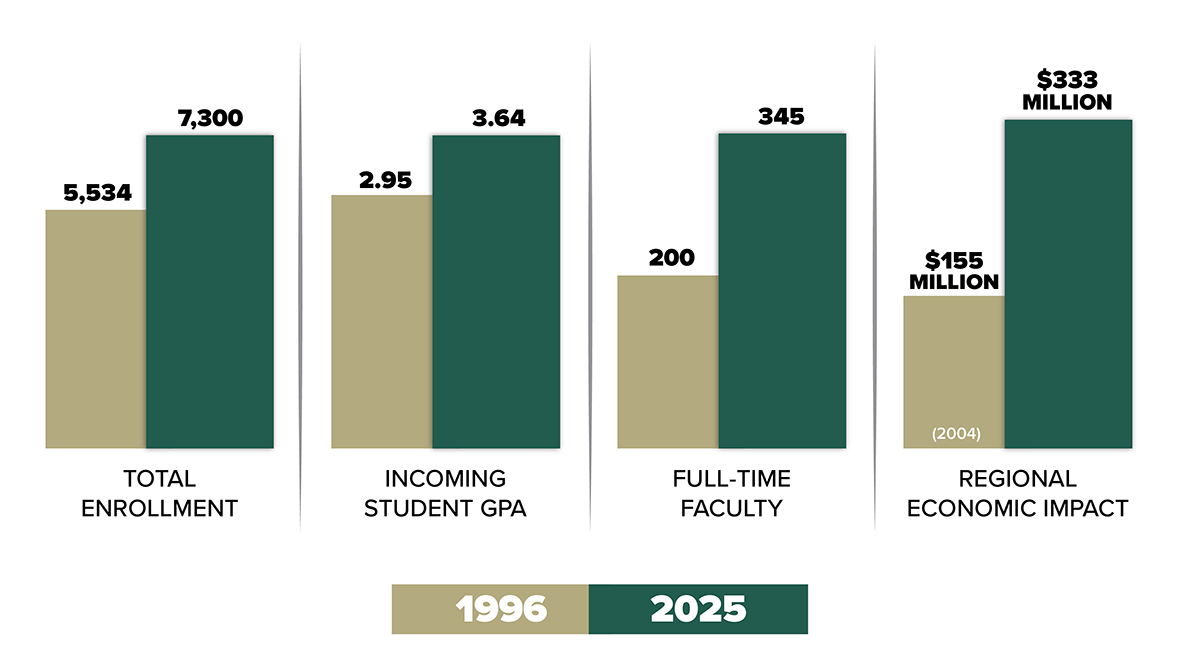
- Reaching the university’s highest enrollment ever in fall 2025 — at over 7,300 students — which put undergraduate enrollment at full campus capacity.
- Receiving more new-student applications than ever before in 2025, with more than 5,000 received before the October “early action” deadline, an 83% increase over the number recorded just three years prior, in 2022.
- Recording an incoming student GPA of 3.64 in 2025, reinforcing GCSU’s place among the “Big Three” selective admissions institutions in the University System of Georgia (along with the University of Georgia and Georgia Tech).
To Cox, these benchmarks are a cause for celebration, but they also position the university at a similar crossroads to the one it faced three decades prior.
“Imagine what Georgia College could accomplish in the next 30 years if we all set our sights on the stars,” Cox said. “Our potential is limited only by our imaginations — and our willingness to make those dreams come true.”
She challenged colleagues to use the strong foundation they have built as a launchpad toward an even brighter future.
“This is not the time to rest,” Cox said. “It’s time to raise the bar.”
Outshining the Status Quo
Thirty years of “identity-shaping work” got the university to its current place of top-five prominence, Cox said, “but what does it mean to stay a top-five university?”
Maximizing Students’ ROI
Although GCSU grads scored in the top three for earning potential among all public colleges and universities in Georgia, four years after graduation, according to a study conducted last year by the U.S. Department of Education, a stereotype still exists that students must choose between developing “hard” or “soft” skills in college. STEM vs. liberal arts. Engaged citizen or agile professional.
But those are false binaries, Cox said, pointing to a 2025 study by the American Association of Colleges and Universities that show that employers are up to 81% more likely to hire graduates who have participated in experience-based learning activities, such as undergraduate research, internships, study abroad, leadership programs and more.
“These types of activities are the foundation of a GCSU education,” Cox said. “Yes, we’re different: 93% of our graduates report having transformative experiences like these — starting in their first year.”
When it comes to designing new programs, she added — including the new master’s in Adaptive AI degree, which the university hopes to roll out later this year — the key is to target workforce need.
“Our students want to see clear career returns on their degrees, and it’s our job to deliver that to them,” Cox said.
Expanding Graduate-Level Offerings
With capacity of undergraduate enrollment limited by the number of bedspace on campus, graduate programs provide the next opportunity for continued university growth.
“This remains the one area where we can truly control our own destiny,” Cox said. “This is why we’re sharpening our focus and increasing our investment in growing graduate enrollment.”
One way of doing that is through additional staffing. The following positions, two of which are newly created, are currently posted online and seeking applicants.
- AVP for Graduate Admissions & Research
- CRM Slate Manager
- Director of Graduate Admissions
Another way is by maximizing program flexibility, including transitioning some of the university’s 47 graduate degree and certificate options into eight- or 10-week accelerated-term formats.
Cox also cited the expansion of GCSU’s Double Bobcat program — which allows undergrads to take up to 12 semester hours in graduate-level course credit, fulfilling requirements for two programs simultaneously and saving students both time and money — as a third avenue for growth.
“We have a number of strong undergraduate majors here with no natural graduate pathways for our students to pursue,” Cox said. “Let’s think about potential Double Bobcat pathways that could serve them well on their journeys to strong careers.”
‘Our Journey to Different’: Then and Now
By 1996, Georgia College had already gone through many iterations: women’s-only, name changes, integration. After over 100 years in higher education, the school was established but needed direction. It found it in its newfound liberal arts mission.
These statistics, and the accompanying graph, illustrate how the university has grown over the past 30 years.
- Endowment growth: about $5 million in 1996 to nearly $70 million today.
- Student-to-faculty ratio: 20:1 in 1996 to 17:1 today.
- Student organizations: 64 in 1996 to 166 today.
- Economic impact: about $155 million generated in 2004 to $333 million today.
Some areas also saw their most significant gains only recently.
- Philanthropic gifts to GCSU, for instance, have grown nearly 400% since just 2023. These funds directly benefit students, such as the recent $9 million gift from Dr. Gertrude Ehrlich, a 1943 alumna who fled Nazi-controlled Austria and ultimately found a welcoming home at Georgia College.
- Georgia College faculty raised a record-high $3.9 million in grant funding in 2025, which created a wealth of undergraduate research opportunities. In fact, nearly 70% of all students currently participate in undergraduate research before they graduate.
- And Bobcat scholar-athletes scored No. 1 in the nation for Academic Success Rate among all DII public schools in the NCAA for the 5th consecutive year in 2025.
This recent success has allowed the university to invest in campus improvements, as well, including:
- A new Esports lab.
- New Simulation and Translational Research Center for nursing students.
- The new $4.5 million Music Rehearsal Hall.
- Major renovations to the Herty Hall academic building.
- And a fully redesigned website, coming soon.
“We used to bristle when people called us the ‘best kept secret in Georgia’, but now it’s clear: The secret is out about Georgia College,” Cox told the crowd. “Through all of these avenues, our biggest strength and our greatest distinction lies in our liberal arts mission. Students continue to flock to GCSU to gain early access to hands-on work, meaningful connections with faculty and staff mentors, and ample opportunities to explore across disciplines.
“We’ve come a long way,” she added. “But the journey is just beginning.”
See more highlights from the State of the University address.
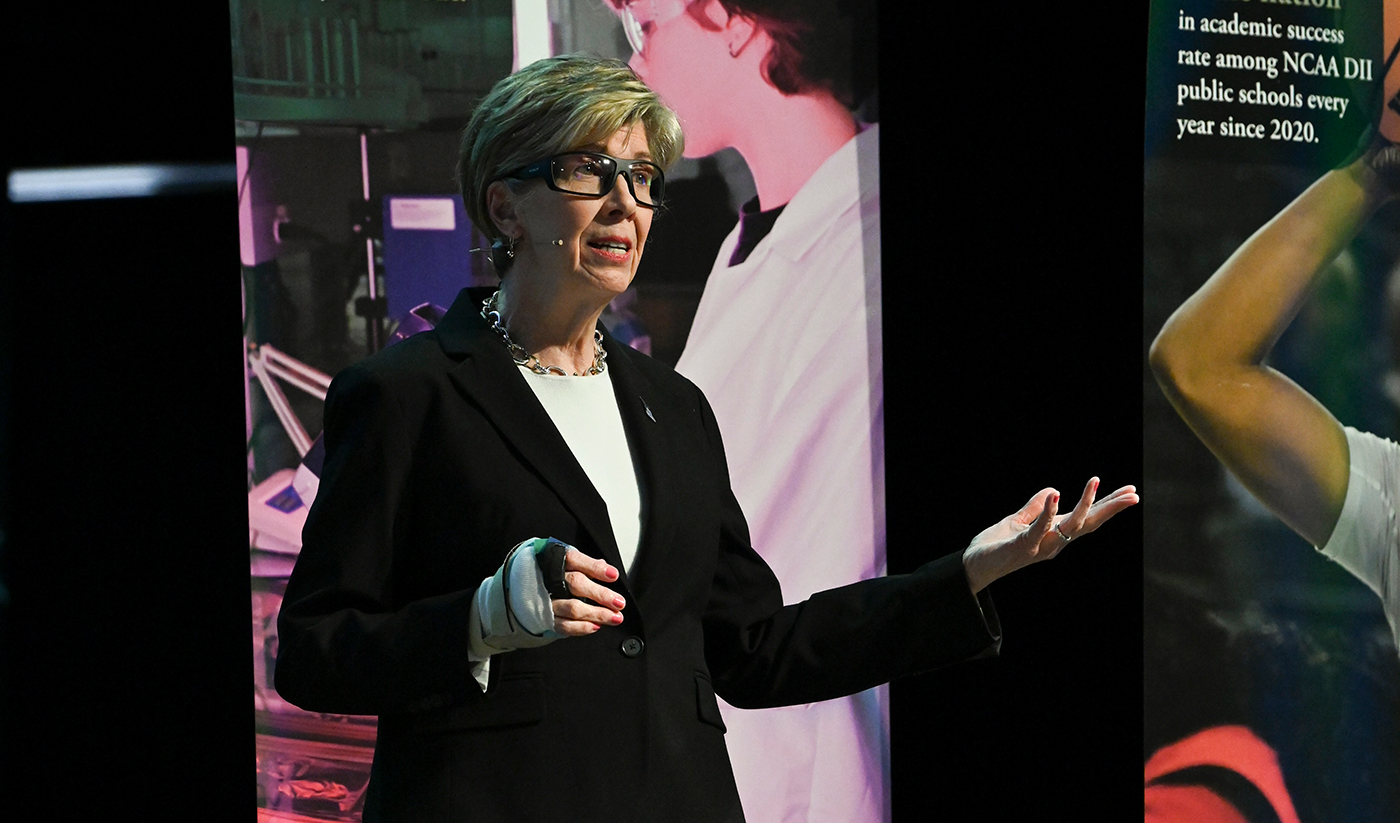
Featured photo: Georgia College & State University President Cathy Cox delivered her 2026 State of the University Address Friday, Feb. 6. (Photo: Anna Gay Leavitt)